Introducing dyadic health - rethinking who's at the table for women's health

Reproductive health. Sexual wellness. Maternity. Menopause.
These are the categories we typically file under "women's health." And in many ways, they are. But there's something this framing often misses: many of these experiences don't happen in a vacuum. They happen in the context of relationships, families, and partnerships.
Fertility is often a shared goal. Sexual wellness can involve a partner. Pregnancy reshapes a household. Menopause affects the people around her, not just her. And yet, much of the healthcare system - and the technology built on top of it - defaults to treating all of it as one person's journey. Her app. Her appointment. Her responsibility.
At Vespexx, we think there's an opportunity to rethink that framing. And we're building technology around a different principle.
We call it dyadic health.
There are two patterns that sit at the heart of this problem.
The first is biological but overlooked. Male-factor infertility is a primary or contributing cause in approximately 50% of infertile couples, according to research published in The Lancet. Half. And yet, most fertility apps on the market are still designed for a single user - her. The partner, at best, might get a notification. At worst, there's no entry point for them at all.
The second is structural and cultural. Studies consistently show that women make approximately 80% of healthcare decisions for their families - scheduling appointments, researching symptoms, managing medications, coordinating care for children and aging parents (Matoff-Stepp et al., 2014). The American Heart Association describes women - especially mothers - as the "chief medical officers" of the household. And yet, 78% of women report putting off their own healthcare because they're too busy taking care of everyone else.
This isn't always a conscious choice. It's more of a structural default - something that builds up quietly over time. The healthcare system assumes women will do this work, and the technology built on top of it reinforces that assumption.
The result, in many cases, is that women end up carrying the full cognitive and emotional weight of health management - not just their own, but their family's - with very little designed support for sharing that load.
This is the question that led to Vespexx.
Not "how do we build a better fertility app for women" - but "what would it look like if the partner was part of the process from the start?"
The difference might sound subtle, but it changes how you design everything. The first question optimizes for the individual. The second invites you to rethink the architecture.
Dyadic health is the principle that women's health outcomes can improve when the people closest to her - starting with her partner - are more actively included in the process. Not as cheerleaders or passive supporters, but as participants with their own data, their own routines, and their own sense of ownership.
This idea isn't limited to fertility. Many aspects of sexual wellness benefit from shared understanding. Postpartum recovery is often shaped by how involved the partner is. Even menopause - frequently treated as the most private of transitions - can look very different when there's relational support around it.
The research points in this direction too. A 2023 systematic review in BMC Public Health found that paternal preconception health behaviours — including body composition, smoking, nutrition, and physical activity — are associated with pregnancy success and offspring health outcomes. The mechanism makes intuitive sense: when both people are informed, engaged, and sharing the load, decisions tend to be better and the experience less isolating.
Vespexx is a subsidiary of Sugentech, a KOSDAQ-listed biotech company with over 20 years in diagnostic technology. Sugentech built its reputation in rapid diagnostic kits and hormone testing - clinical-grade infrastructure that gives Vespexx a foundation most femtech startups don't have access to.
What makes Vespexx distinctive isn't just the technology. It's who's building it.
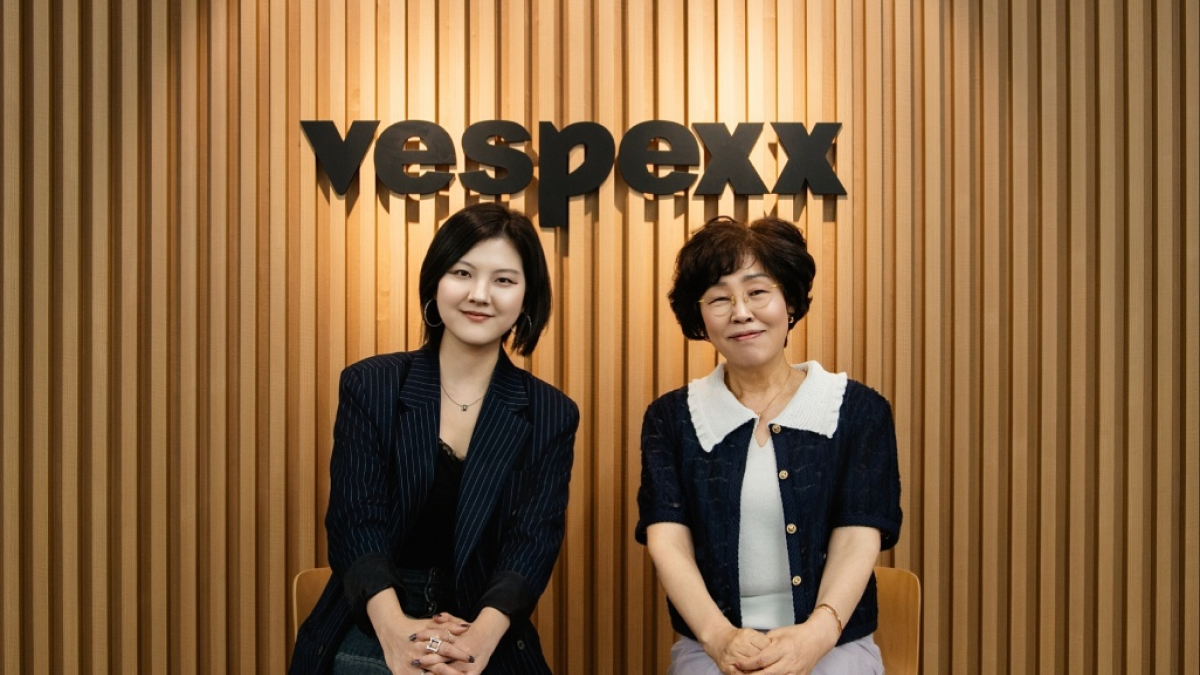
Dr. Mi-jin Sohn, CEO & Co-Founder, is a rare figure in Korean healthcare: a woman leading a biotech company in a landscape where that's still uncommon. She holds a Ph.D. in biotechnology, spent years as a senior researcher at LG's Biotech Research Center, and went on to found Sugentech - growing it into one of Korea's key players in the global diagnostics market. She served as Chairman of Korea's In Vitro Diagnostics Companies Association. She's also a mother of two.
Dr. Sohn didn't start Vespexx because femtech was trending. She started it because she saw, from both science and life experience, that women's health technology was missing something important.
Scarlett Joowon Jung, CEO & Co-Founder, brings nearly a decade of experience in Korea's femtech space. Before Vespexx, she founded one of Korea's first AI-powered women's health startups. Her background spans finance, investment management, and AI ventures - a combination that shapes how she thinks about sustainable, scalable product design.
Jung's career has been guided by a consistent belief: that technology can help couples experience health together in a more meaningful way. At Vespexx, she and Dr. Sohn are putting that belief into practice.
Women leaders in Korean healthcare are still uncommon. At Vespexx, they're running the company.
Dyadic health isn't just a philosophy. It's a product design principle, and it started with Signaling.
Signaling is Vespexx's flagship couples app, a shared calendar and wellness platform that makes sharing your cycle with your partner easy and natural. Since launching, Signaling has grown to over 750,000 users across 100+ countries, with 240,000 monthly active users and an industry-leading 71% week-over-week retention rate. It's earned a 4.9-star rating on iOS and was featured as an App Store recommendation.
What Signaling proved is that couples want shared health tools. The interest isn't hypothetical - hundreds of thousands of people are already using one.
Building on that foundation, Vespexx developed Soonr - a couples-centric preconception health optimization app. Both partners connect in seconds. Both can see each other's daily health logs and streaks. Both get daily routines - supplements, exercise, nutrition - tailored to their role in the preconception journey. Gamification helps both partners stay accountable. Cycle and ovulation tracking gives both partners shared visibility into where they are.
The idea is simple: instead of one person managing everything, both partners have a shared protocol, shared data, and a shared plan.
And soon, Soonr will be adding an at-home hormone testing kit, powered by Sugentech's diagnostic technology. Real-time hormone data, synced directly to the couple's shared dashboard.
This is what dyadic health looks like in practice. Not an app for women with a "share with partner" button added as an afterthought. A system designed from the ground up for two people.
Preconception health is where we're focusing now. But we believe the dyadic health framework has the potential to extend across a much wider spectrum of women's health.
Signaling already showed us the demand. Over time, our roadmap extends into sexual wellness, postpartum support, and eventually, areas like menopause and aging - always guided by the same principle. Women's health outcomes can improve when the people around her are part of the conversation.
The healthcare system has spent decades building around the individual. We think there's room to build around the relationship too.
Because she's been carrying it long enough. It's time the system shared the load.